Build / Apparel
Better blanks.
Better first impressions.
The difference between merch and product is usually the blank, the trims and whether anyone checked how the print sits on that specific fabric. Those are the three things we do not leave to the supplier's default.
Product
What we build.
Hoodies and crews
Midweight through heavyweight fleece, standard and boxy fits, garment dye and wash options.
Available now
T-shirts
Standard through heavyweight cotton, boxy and regular fits, long and short sleeve.
Available now
Cut-and-sew
Custom patterning where a blank will not carry the idea. Longer lead time and higher minimums.
Available on scoped programmes
Outerwear
Coaches jackets, varsity and heavier layers for capsule and premium programmes.
Available on scoped programmes
Custom labels and trims
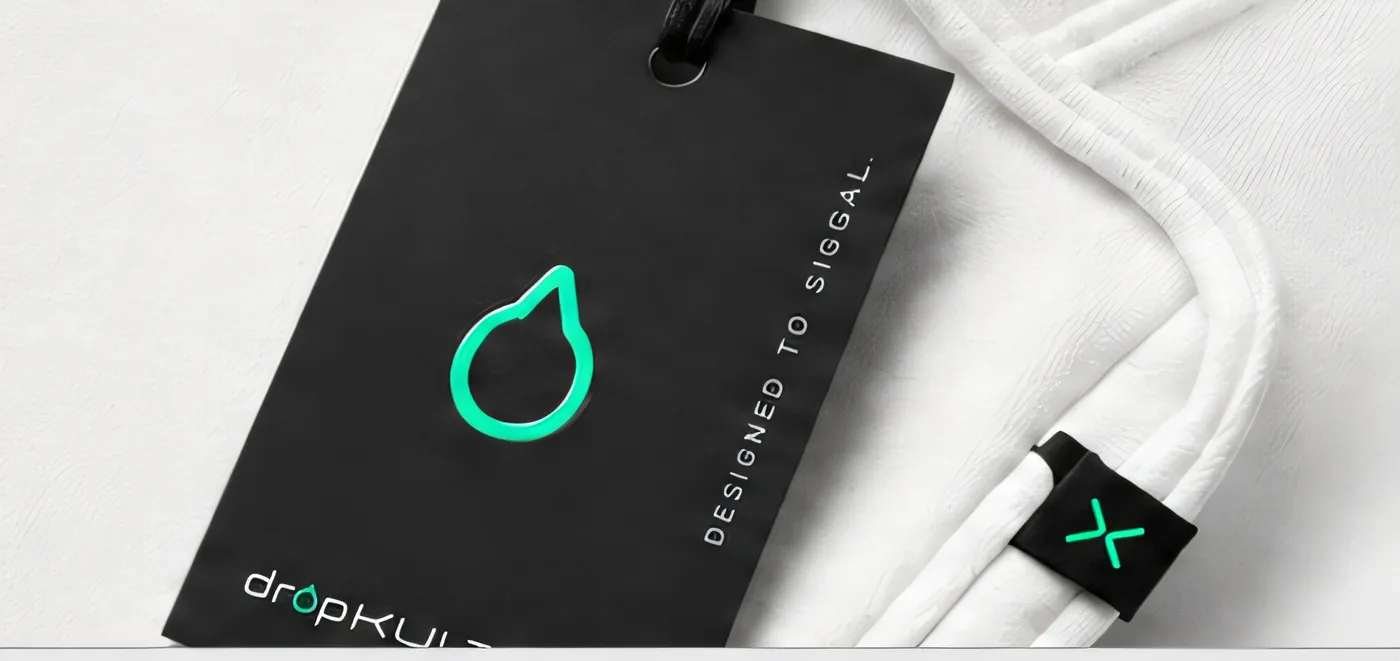
Neck labels, hem tags, drawcords, zip pulls and packaging that make a blank read as a brand.
Available now. Needs committing earlier in the timeline than the print does.
dKR authentication
Neck label, sleeve hit, hangtag or packaging seal binding the item to its approved product record.
Physical application available, and a code can be verified at /dkr/verify/.
Decoration
Choosing a method.
Indicative guidance. Real suitability depends on the blank, the artwork and the quantity, and we confirm it per programme rather than applying a rule.
| Method | Best for | Watch out for | Typical minimum |
|---|---|---|---|
| Screen print | Bold flat colour, larger runs, the most durable hand feel | Per-colour setup makes small multi-colour jobs expensive | Medium |
| DTF transfer | Detailed and full-colour work, small runs, mixed garment types | Different hand feel to screen; struggles on heavy texture | Low |
| DTG | Photographic detail, sampling, seeding and one-offs | Best on high-cotton blanks; dark garments need underbase care | Very low |
| Embroidery | Premium chest hits and anything that should feel substantial | Small text and fine line work do not survive stitch resolution | Low to medium |
| Patches and appliqué | Collector feel, varsity and heavyweight programmes | Adds cost and lead time; judge from a sample, not a render | Medium |
| Garment dye and wash | Vintage character and a premium finish across a whole run | Shade variation between units is inherent, not a defect | Medium to high |
Print placements
See where it goes before you design it.
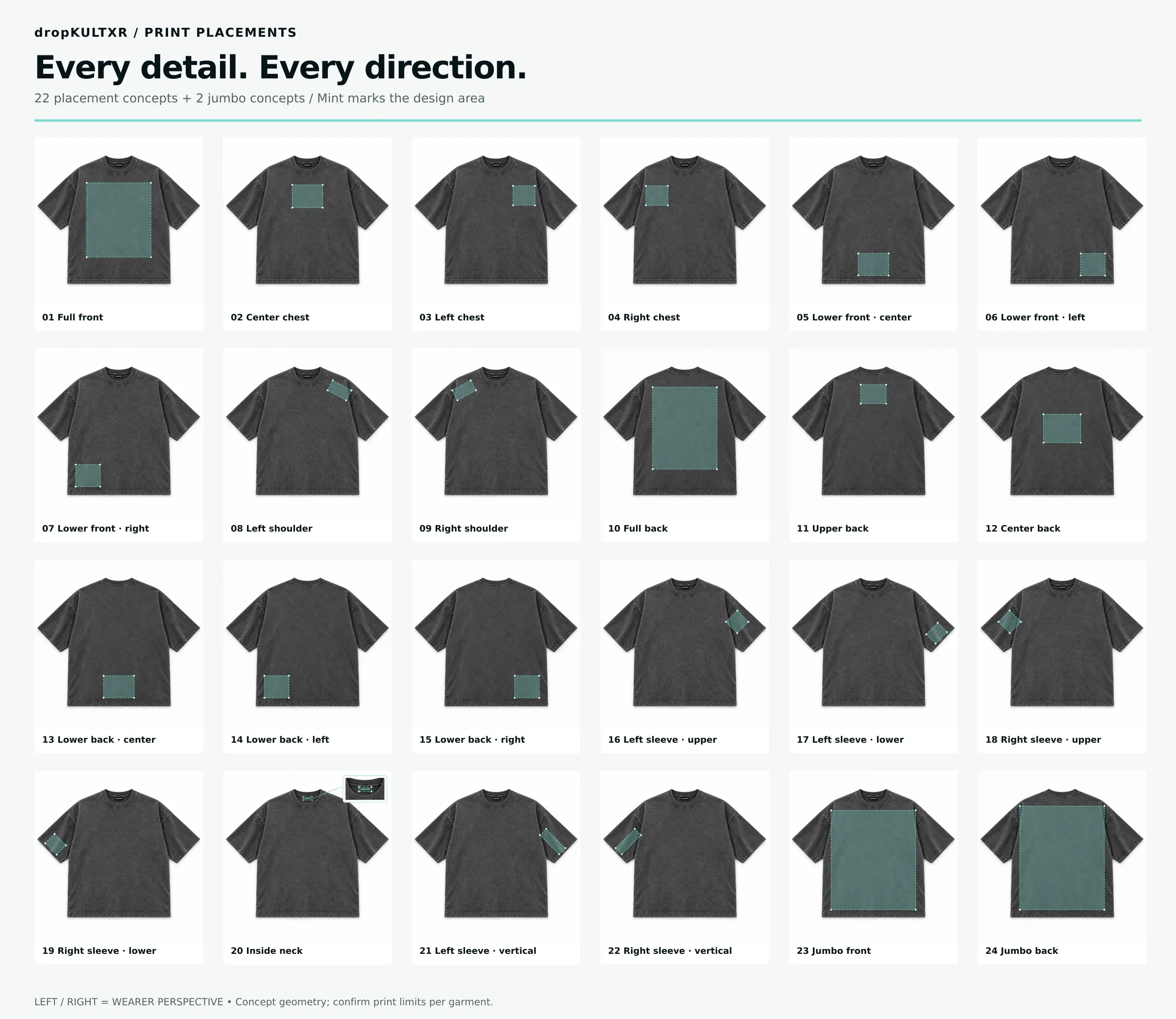
Twenty-two places to put a design on a T-shirt, and two jumbo areas past the usual limits. Pick one to see where it sits, then combine as many as the idea needs.
Full front
The main event. A graphic that carries the whole garment, sized to the body rather than the chest.
Center chest
A wordmark or badge that reads straight on, big enough to see across a room.
Left chest
The classic small mark over the heart. The first thing a buyer checks, and the natural home for embroidery.
Right chest
A small mark on the less expected side, or a partner mark opposite a left-chest logo.
Lower front · center
A quiet detail above the hem that rewards a second look.
Lower front · left
A hem-corner hit, where a tag line, date or edition number sits well.
Lower front · right
The mirror of the left hem corner, for a secondary mark or a paired detail.
Left shoulder
Angled along the shoulder seam. Reads from the side and in photographs taken at three quarters.
Right shoulder
The other shoulder, for a short word, a flag or a sponsor mark.
Full back
The biggest standard canvas: tour lists, artwork, the statement piece people see walking away.
Upper back
Just below the collar. A small mark that shows above a jacket or a backpack strap.
Center back
A mid-size back graphic, between the neck hit and a full back.
Lower back · center
A detail above the back hem, often a city, a year or a collection name.
Lower back · left
A back hem corner on the wearer’s left.
Lower back · right
A back hem corner on the wearer’s right.
Left sleeve · upper
A sleeve hit near the shoulder, the usual place for a secondary logo.
Left sleeve · lower
Down by the cuff, where a small icon catches the eye when the arm moves.
Right sleeve · upper
The upper right sleeve, often paired with a left sleeve mark.
Right sleeve · lower
The right cuff area, for a number, a flag or a date.
Inside neck
A printed label inside the collar: size, care and your brand, instead of the blank maker’s tag.
Left sleeve · vertical
A long mark running down the sleeve, made for a word that reads along the arm.
Right sleeve · vertical
The same run on the right sleeve.
Jumbo front
Oversized, past the standard full front toward the seams and hem. Needs a larger screen or a gang-sheet transfer, so it is confirmed per garment.
Jumbo back
The whole back as one image. The loudest placement there is, confirmed per garment and per method.
Left and right are the wearer’s. Areas are concept geometry; the print limit is confirmed per garment and method when we quote.
22 placements and 2 jumbo areas. Combine as many as the design needs.
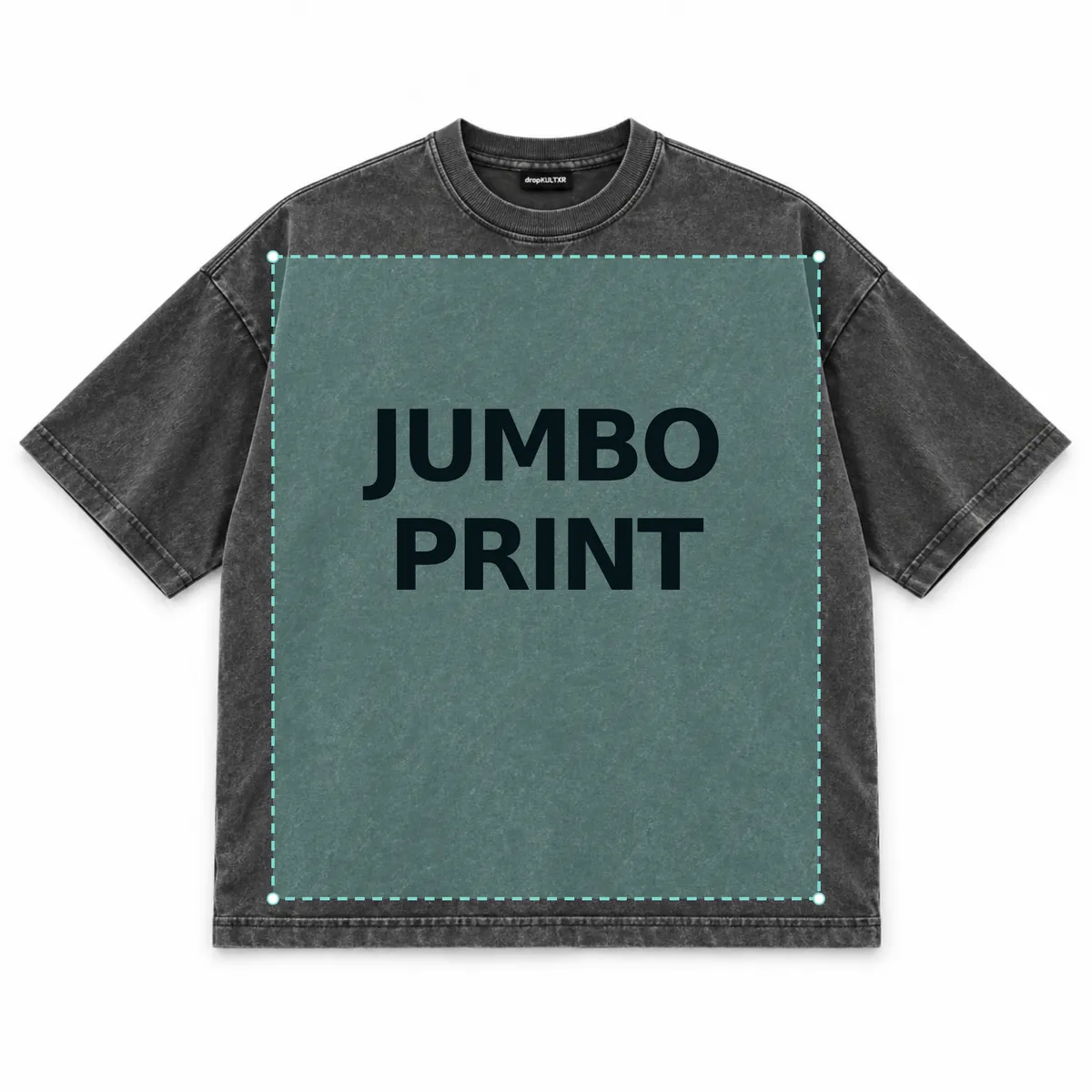
Jumbo, when the garment is the canvas.
A jumbo print runs past the standard full front toward the seams and the hem. It changes the method, the screen size and the price, so we confirm it against the exact blank before quoting.
Constraints worth knowing before you design
Placement has safe zones. Seams, pockets, zips and hoods all interrupt a print. A design that crosses a side seam will distort, and a chest hit that sits too high reads as a mistake on a real body rather than on a flat mockup.
Heavyweight fabric changes the print. A heavier, brushed or textured fleece will not hold fine detail the way a smooth midweight tee will. If the artwork depends on hairline detail, the fabric choice is part of the artwork decision.
Colour matching has limits. We work to a colour reference and get close, but dye lots vary, fabrics take ink differently, and a screen on a garment will never be an exact match to a screen on a monitor. We show you a sample and that is the reference point.
Trims drive the timeline more than prints do. Custom neck labels, woven tags and packaging usually have longer lead times than the decoration itself, so they have to be committed earlier. This surprises people, and it is the most common cause of a slipped launch date.
Bring us the product.
Tell us the category and the direction. We come back with blanks, methods and a real timeline.