Build / Launch with experts
Your drop.
Our team behind it.
Most first drops go this way. Our team runs the operation end to end and you approve at defined points, with the cost, margin and timing consequences of each decision visible when you make it rather than after.
What we run
The whole operation, or the parts you need.
You can start anywhere. Plenty of programmes bring us in for sourcing and production while the client keeps creative in-house, and that works fine.
Product strategy
Audience, product mix, price architecture, margin targets and the launch plan.
Creative direction
Product identity, graphics, apparel direction, packaging and campaign assets.
Tech packs and art prep
Separations, placements, dimensions and colour references a factory can work from.
Sourcing
Blanks, cut-and-sew, specialty goods and the supplier that actually suits the job.
Production management
Purchase orders, milestones, sampling, QA and exception handling.
Storefront and drop
Launch calendar, pre-orders, QR ordering, email and SMS, and limited access mechanics.
Fulfilment
Storage, pick and pack, returns, VIP boxes, seeding kits and event logistics.
Reporting
Sell-through, conversion, fan capture and sponsor-facing reporting after the drop.
How we are structured, and why it matters to you
We own the strategic, creative, commercial and data layers, and we scale production through a vetted partner network rather than owning factories. That is a deliberate choice: a capital-heavy factory has to keep its machines busy, which distorts every product recommendation it makes.
Light production is handled in-house — sampling, small runs, DTF and DTG tests, labels and hangtags, VIP box assembly, event prep and packaging systems. That is the work where turnaround and control matter more than unit cost, and where waiting on an external partner kills a timeline.
Bulk screen print, cut-and-sew, headwear, dye and wash, sublimation and high-volume fulfilment go to partners selected per job. Suppliers are non-exclusive and product records are factory-neutral, so a supplier problem is a routing decision rather than a crisis.
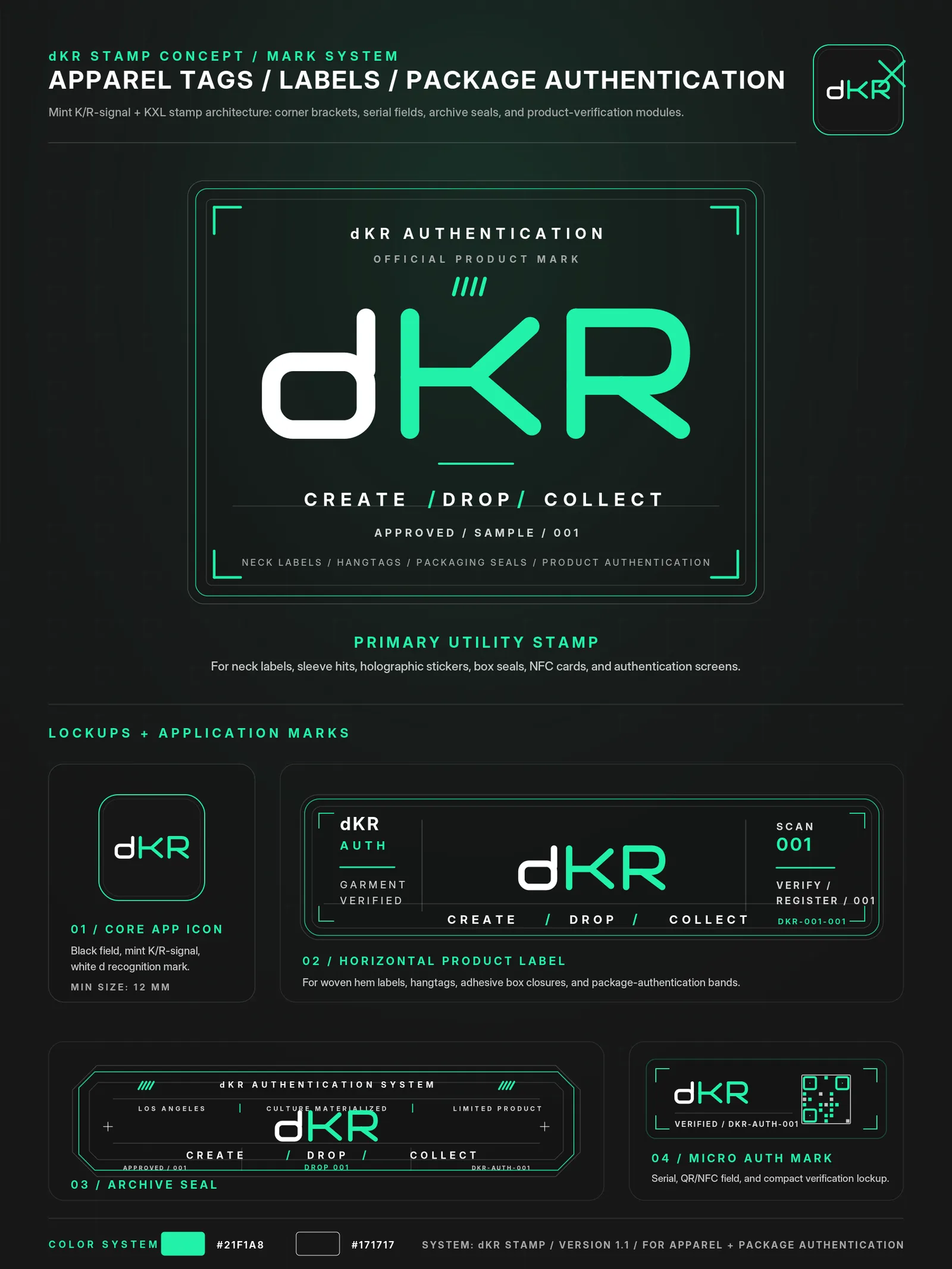
Quality control and dKR authentication stay with us regardless of who produced the goods. Those are the two things that cannot be delegated without the standard drifting.
What you can expect from us
The commitments.
One business day
Every qualified brief gets acknowledged and assigned a named owner within one business day. Not a ticket number.
Economics beside decisions
Landed cost, retail, contribution and royalty are shown while you are still deciding, with the date and confidence of every cost figure.
Approval binds a version
You approve an exact artifact at an exact version. A material change invalidates that approval and creates a new decision rather than sliding through.
Sample before scale
No production run proceeds without an approved physical sample. On every programme, without exception.
Rights fail closed
Outstanding clearance stops the programme rather than generating a warning somebody dismisses.
Your data is exportable
Products, designs, assets, suppliers, orders, economics and approvals come out in a structured format if you ask.
Questions we get asked
How much of this do we have to do ourselves?
Approvals, rights clearance and the decisions only you can make. Everything else can sit with us. The approval points are deliberate rather than bureaucratic — they are where cost, legal exposure and quality get locked in, and they need a person from your side.
What does a first programme usually look like?
One category, one clearly-defined moment, a controlled quantity. We would rather prove the operation on a hoodie drop that ships clean than start with a six-category range and discover the process problems at scale. The second programme is where volume goes up.
Do you work with our existing suppliers?
Often, yes. If you have a factory relationship that works, keeping it is usually the right call and we can route to it. What we will do is hold the same QA standard and the same data requirements regardless of who is producing.
What happens when something goes wrong in production?
You get told, with what happened, what it affects, what we are doing and a recovery date. Exceptions are tracked with an owner and a resolution rather than absorbed quietly and explained at the end. Retail-quality merch programmes go wrong sometimes; the difference is whether you find out in week three or week nine.
How is this priced?
Programmes are scoped rather than sold from a rate card, because the shape varies enormously between a single creator capsule and a multi-city event programme. The programmes page describes the package types and what drives cost. We will give you a real number against a real brief.
Send the brief.
Acknowledged straight away, named owner within one business day, honest read on whether your timeline works.